Why Do Online Slots Still Have Reels If It’s Just Software?
Open an online slot and the first thing you may see is familiar: columns of symbols slide, stop and line up in rows. It looks like a machine with reels. But in many online games, there are no rotating strips of paper, no motor and no mechanism deciding where a reel stops. The moving symbols are an interface: a way of showing a software-generated result in a form players already recognise.
That distinction matters. Animated reels are what the screen shows; the software underneath determines the result. The reel image may borrow the visual language of a physical slot machine without reproducing its mechanics. To understand why that language has lasted, it helps to look at the objects, layouts and routines of gambling history—not just the games themselves.
First, separate the picture from the mechanism
On a traditional mechanical slot machine, the reels are physical objects: printed strips mounted around drums. A player pulls a lever or presses a button; a mechanism starts the drums moving, and they come to rest to display a combination of symbols. The symbols are visible evidence of the machine’s outcome, although the internal mechanism and paytable determine what combinations are possible and what they pay.
On a digital slot, the apparent reels are usually graphical elements rendered on a screen. A random-number generator (RNG) selects an outcome according to the game’s software and rules. The animation then presents that outcome: symbols scroll, slow down and stop in sequence. That animation can make the result legible and entertaining, but it is not proof that physical reels—or a mechanical process—are operating behind the screen.
This is the key difference between what is seen and what is happening. A digital interface can depict motion, stopping and symbol alignment without any physical object moving. Conversely, a live stream may show actual equipment in use. The two views can look similar on a small screen, but they do not show the same kind of mechanism.
How the reel became a familiar interface
Slot machines developed as tangible public entertainment. Their physical features shaped the experience: a cabinet held the machinery, a coin slot accepted payment, a lever or button invited an action, and the front panel displayed symbols and instructions. The machine was not just a game outcome. It was an object designed to be approached, operated and watched.
Early mechanical machines used rotating drums and symbols, making the reel a literal part of the equipment. Later electromechanical machines retained visible reels even as electrical components increasingly controlled their movement. Video slots then replaced physical reels with screens, but kept the familiar arrangement of columns and rows. Online games inherited that screen-based format.
This history is object-led: the interface did not appear in a vacuum. It grew from cabinets, handles, coin mechanisms, paytables and the social settings in which machines were placed. Each generation changed the equipment while keeping some cues from the one before it. The reel image became a kind of shorthand for “slot game”, even when the underlying process no longer involved a reel.
That shorthand is what we mean by visual convention slots: recurring visual forms—reels, symbols, paylines and stopping animations—that tell a player how to read the game. A convention can remain useful after the original object has disappeared. A digital clock does not contain a mechanical clockwork movement, and a digital slot’s reel animation does not need a physical drum.
What reels do for a player
Animated reels organise information. They divide the screen into a set of positions, making it easier to see which symbols have appeared and how they relate to the game’s rules. If a game uses five columns and three visible rows, the grid offers a readable field for combinations, bonus symbols and other features.
The motion also gives a clear sequence to the interaction:
-
The player chooses a stake and starts a round.
-
The game presents a short animation, with symbols moving through the visible grid.
-
The symbols stop, and the interface highlights or otherwise displays the result.
-
The game updates the balance and presents any win, feature or next-step information.
The animation creates a visible interval between starting a round and seeing its result. It may lend the action a sense of anticipation, but it should not be confused with the software selecting an outcome in real time as the images pass. The outcome is governed by the game’s software and rules; the animation is how the result is presented to the player.
The reel grid also acts as a map. A player can identify the active play area, see which symbols are relevant, and understand where a winning pattern is being shown. If the game instead displayed only a number or a line of text, it might communicate a result efficiently, but it would lose the recognisable structure that has long defined slot play.
Equipment shapes actions—even when the equipment is virtual
Physical machines invite particular actions. A handle can be pulled; a button can be pressed; a coin can be inserted. These controls make the machine’s operation apparent. A digital interface translates those actions into touch, mouse or keyboard inputs, but it still needs to tell the player what can be done and what happens next.
That is one reason a screen may retain an on-screen “spin” button, a stake selector and a reel grid. They divide the game into understandable tasks: set a stake, start a round and inspect the result. The interface is not simply a picture of old machinery. It is also a designed arrangement of controls and information.
The physical and digital experiences differ in handling. A person using a cabinet may feel a button travel, hear a mechanism or see the whole machine in front of them. An online player touches a screen or clicks a control; the response is visual and may include sound or vibration, depending on the device. The animated reel supplies continuity with the older form, while the actual handling is now mediated by a digital device.
This distinction is especially useful when looking at a live stream. A stream showing a physical machine in use can reveal the cabinet, controls, lighting and the movement of equipment. But the camera only records what is in view. It may show the front of a machine without exposing its internal mechanism, or show a player’s hand without revealing how the software and rules operate. A streamed image is evidence of visible activity, not a complete technical account.
Visibility, handling and the record of a result
Gambling equipment has to make results visible in a usable way. On a physical machine, the symbols, paytable and controls help a player connect an action to an outcome. On a digital slot, equivalent information must fit within a screen that could be a phone, tablet or computer. The interface has to show the game area, relevant rules and the player’s balance without relying on a large cabinet or printed panel.
Recording results is another design concern. A physical machine can display a result on its reels and update a credit meter. A digital game can display the result, update a balance and record the round in software. These are different forms of record: one is presented through visible equipment, while the other is stored and rendered by a digital system. Seeing animated reels alone does not tell a viewer what data was recorded or how the result was generated.
For a museum researcher, the useful question is not merely “Does it look like a slot machine?” but “Which parts of the old arrangement have been retained, and which have changed?” The reels may survive as a visual grid; the lever may become a button; the cabinet may become a phone screen; the coin path may be replaced by a digital account interface. Looking at the objects—and the actions they permit—shows how much of the experience is inherited and how much is new.
Why tables and marked areas matter
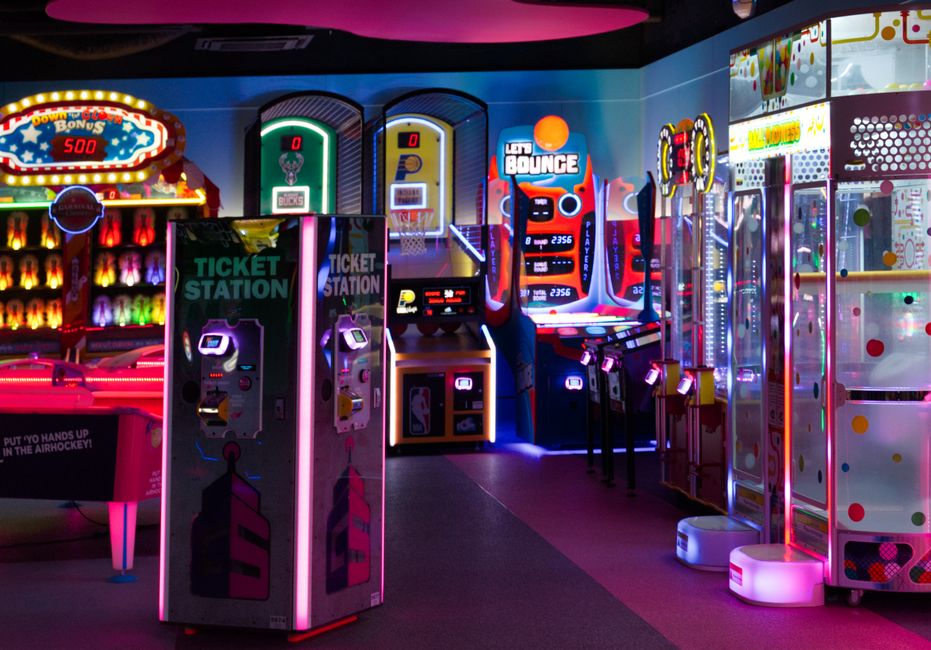
Slot machines are often discussed as if they exist only as isolated cabinets or screens. Yet gambling equipment has always been shaped by its setting. A casino floor arranges machines in rows, defines paths between them and places controls and displays where players can approach and use them. The physical layout affects access, visibility and how people move through the space.
Tables offer an even clearer example of layout as functional equipment. In table games, the marked surface is not decoration: it shows where bets go, what options are available and how the game is organised. The dealer, players, chips and printed areas work together as a practical system. The markings help turn a large tabletop into a shared interface.
Online games borrow this principle. A reel grid, highlighted paylines, buttons and information panels mark out active areas on the screen. Their placement indicates where to look and what to do. But the comparison has limits: a marked digital grid is not a physical table, and an animated reel is not a rotating drum. They are screen-based arrangements that perform some of the same communicative work—organising choices and making outcomes visible—through different means.
Feature Physical equipment Online interface Game area Visible reels or a marked table surface Animated reels, grids or marked screen areas Player action Pulling a handle, pressing a button or placing a chip Touching or clicking an on-screen control Result display Symbols, markers, chips or a credit display Rendered symbols, highlights and updated account information What a viewer can observe Some visible actions and equipment, depending on the camera angle The interface and its animation, not physical reel movementWhat a live stream can—and cannot—show
Live streams are useful for studying equipment in context. They can show how a player approaches a machine, how controls are handled and how a physical game occupies space. A view of a casino floor may also show the relationship between machines, walkways and casino card handling techniques other equipment. Those details help explain the practical setting of gambling, which a close-up of a symbol grid cannot.
But a photograph or stream may show only part of the equipment. A tight camera frame can omit the cabinet, the player’s surroundings or the area where stakes and results are recorded. Even a wide shot cannot necessarily reveal the internal mechanism. Captions should therefore describe what is actually visible—such as a hand pressing a button or symbols moving on a screen—rather than claim more than the image establishes.
The same caution applies to digital interfaces. Animated reels show a visual sequence. They do not, by themselves, demonstrate mechanical operation, explain the RNG or disclose every rule. To understand those features, one needs information about the game’s software, configuration and stated rules, not just an animation that resembles a physical machine.
Why the reels remain
Online slots still have reels because the reel grid is a clear and familiar way to organise a game. It connects today’s screen-based formats with the visible drums of earlier machines, gives players a place to read symbols and patterns, and creates a sequence in which a result can be presented.
That does not make digital and mechanical slots the same. One uses physical equipment whose components move; the other may use software to select and display a result through animated imagery. The resemblance is meaningful as design history, but it should not be mistaken for identical operation.

So when looking at a slot—on a casino floor, in a photograph, or on a phone—it helps to ask two questions. What is the interface showing? And what mechanism is producing the result? Reels answer the first question by providing a familiar visual convention. The second depends on the equipment or software behind the display.